as part of [T199979]
Would be interesting if we could do Federated searches between TORA and Wikidata see video and start understand how to design WD - Federated search (Linked data fragments??!?!)
NOTE: My understanding of how this should be set up is 0 but I have seen some tests
NOTE: It looks like this will als impact how a TORA object is mapped in Wikidata [[T199794]]
How to
IMPORTANT: this needs to be investigated further
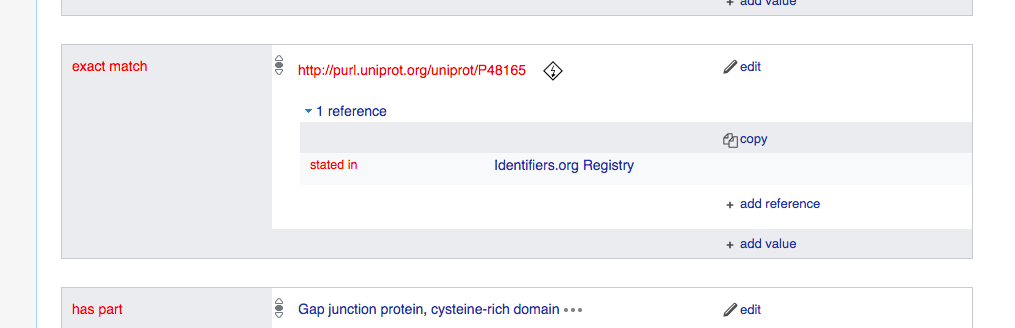
I can see that Q21113158 is used in this query and has property Property 2888 exact match
wdt:P2888 ?iri ;
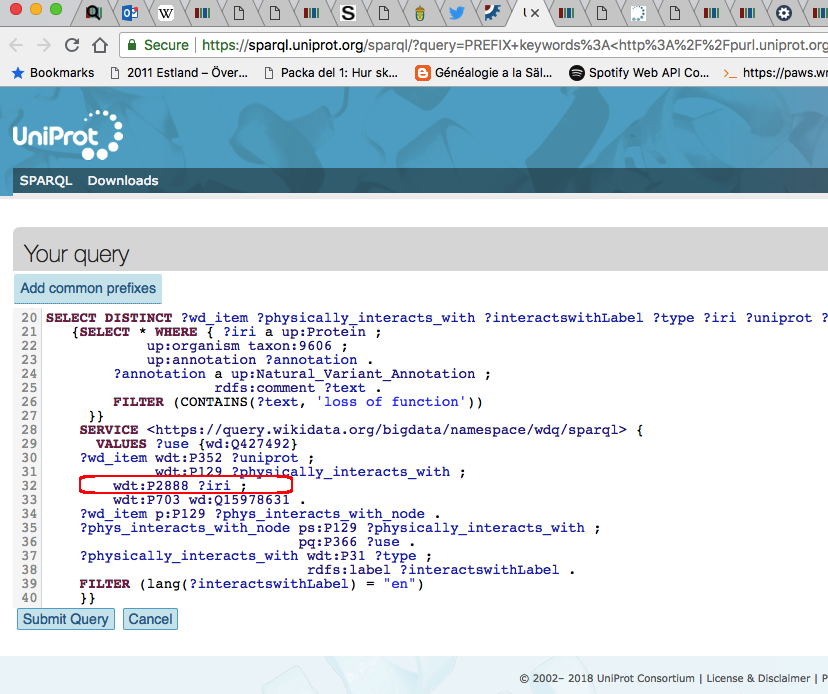
and that Q21113158 has Q21113158#P2888 set as https://www.uniprot.org/uniprot/P48165
More
- about the project Wikidata as a semantic framework for the Gene Wiki initiative
- Github GeneWikiCentral
Example
See
- video of what we try to do
- Wikidata:SPARQL_federation_input
- Query examples
- Blog Integrating Wikidata and other linked data sources – Federated SPARQL queries
- Presentation "Introducing federated queries with Wikidata" - Andra Waagmeester @Andrawaag twitter Github Wikidata
Example "external" SPARQL query see example
PREFIX keywords:<http://purl.uniprot.org/keywords/>
PREFIX uniprotkb:<http://purl.uniprot.org/uniprot/>
PREFIX ec:<http://purl.uniprot.org/enzyme/>
PREFIX rdf:<http://www.w3.org/1999/02/22-rdf-syntax-ns#>
PREFIX skos:<http://www.w3.org/2004/02/skos/core#>
PREFIX owl:<http://www.w3.org/2002/07/owl#>
PREFIX bibo:<http://purl.org/ontology/bibo/>
PREFIX dc:<http://purl.org/dc/terms/>
PREFIX xsd:<http://www.w3.org/2001/XMLSchema#>
PREFIX faldo:<http://biohackathon.org/resource/faldo#>
PREFIX up:<http://purl.uniprot.org/core/>
PREFIX taxon:<http://purl.uniprot.org/taxonomy/>
PREFIX rdfs:<http://www.w3.org/2000/01/rdf-schema#>
PREFIX wdt: <http://www.wikidata.org/prop/direct/>
PREFIX wd: <http://www.wikidata.org/entity/>
PREFIX pq: <http://www.wikidata.org/prop/qualifier/>
PREFIX ps: <http://www.wikidata.org/prop/statement/>
PREFIX p: <http://www.wikidata.org/prop/>

SELECT DISTINCT ?wd_item ?physically_interacts_with ?interactswithLabel ?type ?iri ?uniprot ?text  WHERE  {
   {SELECT * WHERE { ?iri a up:Protein ;
		    up:organism taxon:9606 ;
		    up:annotation ?annotation .
		?annotation a up:Natural_Variant_Annotation ;
		            rdfs:comment ?text .
		FILTER (CONTAINS(?text, 'loss of function'))
     }}
    SERVICE <https://query.wikidata.org/bigdata/namespace/wdq/sparql> {
      VALUES ?use {wd:Q427492}
    ?wd_item wdt:P352 ?uniprot ;
             wdt:P129 ?physically_interacts_with ;
        wdt:P2888 ?iri ;
        wdt:P703 wd:Q15978631 .
    ?wd_item p:P129 ?phys_interacts_with_node .
    ?phys_interacts_with_node ps:P129 ?physically_interacts_with ;
                              pq:P366 ?use .
    ?physically_interacts_with wdt:P31 ?type ;
                               rdfs:label ?interactswithLabel .
    FILTER (lang(?interactswithLabel) = "en")
    }}
Define endpoints in Wikidata
see also
- [[T200073]] Using Shape Expressions for data quality and consistency in Wikidata Quote: Wikidata is fundamentally a graph, so ShEx can be used to validate Wikidata items, communicate expected graph patterns, and generate user interfaces and interface code.
- Exchange and understand each other’s models
- Express a shared model of our footprint in Wikidata
- Agilely develop and test that model against sample data and evolve
- Catch disagreement, inconsistencies or errors efficiently at input time or in batch inspections.
- [[T199998]] and Libris XL
- Example Pivot Edit Wikibase-UserGroup
- Overview Wikidata/Wikibase federation and distribution
- Linked data fragments
- Linked data explained - Linked Data EngineeringProf. Dr. Harald Sack
- A Formal Framework for Comparing Linked Data Fragments
- Advice from linked data implementers